
Let Us Bow Our Heads
saying grace

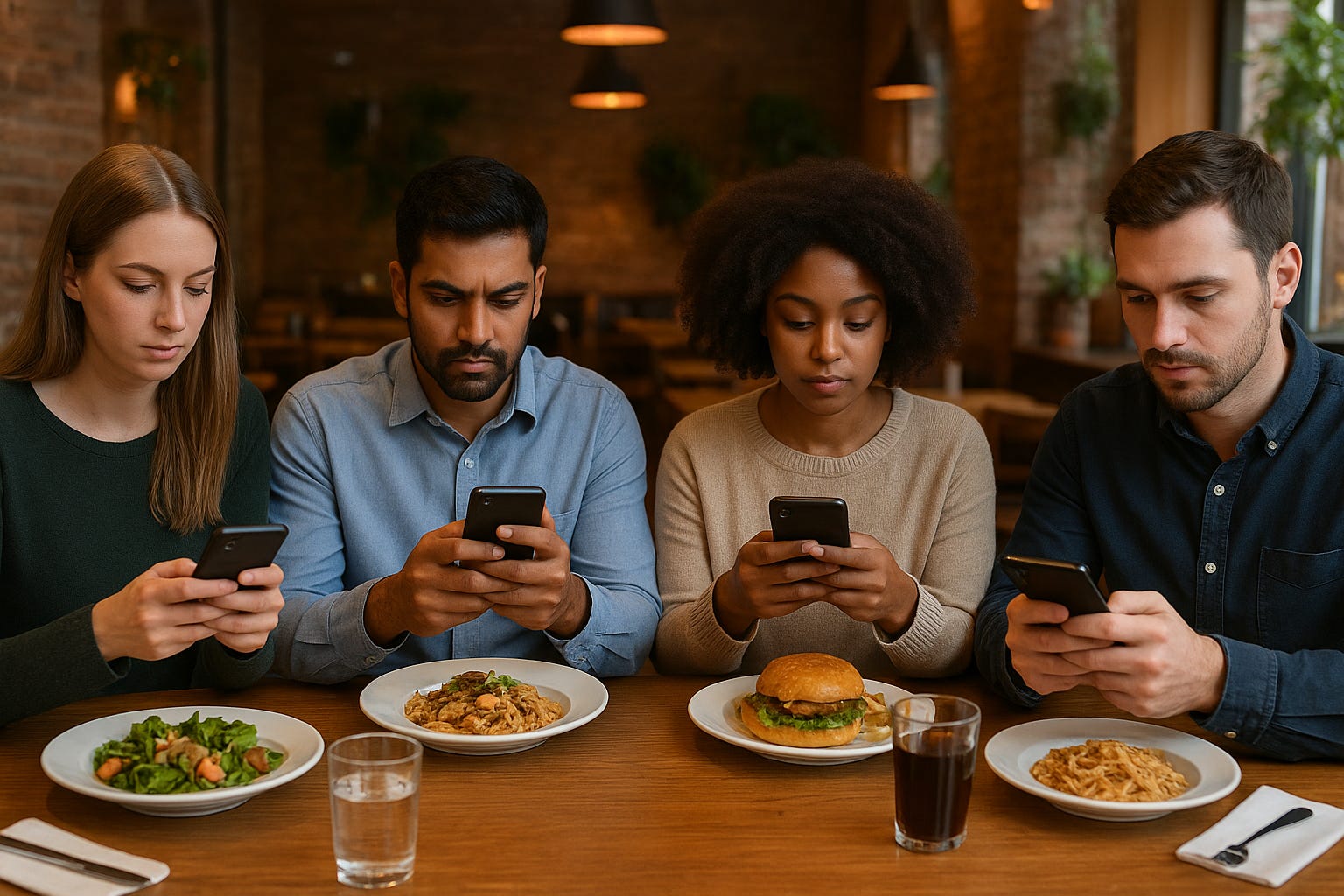
I was waiting at the greeting desk in a restaurant. Looking into the dining area I saw a table with three couples, six people. They were all looking down, praying.
I’m from the South. I understand having grace to thank the lord. Made me smile. Here, in a world gone to hell, were six people pausing to acknowledge something larger than themselves.
As we followed the girl seating us I got a closer look.
They were all looking down at their cell phones.
Not praying. Scrolling.
Nobody was talking. Nobody was eating. Six people had driven to the same restaurant, sat at the same table, and proceeded to ignore each other with the kind of dedication monks reserve for silent retreats. At least monks are pursuing enlightenment. These folks were pursuing Instagram.
I laughed at myself. Of course they weren’t praying. In the United States today, the average person spends seven hours a day staring at a screen. That’s more time than most people spend sleeping. We check our phones 144 times a day—roughly once every six minutes we’re awake. If we devoted that kind of attention to god, we’d all be saints.
Then I went to Canada.
Same thing. Except this time I was a participant. Bored senseless at dinner, I called the fellow across the table from me. He answered. We had a perfectly nice conversation while our wives stared at their own devices. Four people, one table, zero eye contact. It was the most connected we’d been all evening.
The experts have a word for this now: phubbing. Phone-snubbing. It sounds like something you’d do to a malfunctioning appliance, but it’s what we do to the people we supposedly love. Studies show couples who phub each other report lower relationship satisfaction. You don’t need a study. You need eyes. Walk into any restaurant and count the tables where people are actually talking.
It gets worse. One in five people admits to checking their phone during sex. Let that sink in. You’re engaged in the most intimate act two humans can share, and somebody’s swiping through notifications. “Hold on honey, let me see if anyone liked my post.” Among millennials, it’s seventeen percent. I don’t know whether to be horrified or impressed by the multitasking.
Eighty-five percent check their phones on the toilet. Twenty-seven percent admit to fear or anxiety when separated from the device—but thirty percent feel worse when they have the phone and there’s no signal. The phone goes everywhere we go, and everywhere we go, we’re somewhere else.
At concerts, audiences hold up phones instead of lighters, recording performances they’ll never watch so they can prove to strangers on the internet that they were there. One musician got so fed up he stopped playing and filmed the audience back. Made his point. Nobody got it. They were too busy filming him filming them.
At funerals—funerals—one in six attendees not only leaves their phone on but actively uses it. Texting, surfing, taking selfies with the deceased. There’s a Tumblr page called “Selfies at Funerals.” I wish I were making that up. Grandma’s in the casket, but hold on, the lighting’s good and I haven’t posted in three hours.
London padded their street posts because people kept walking into them face-first. That’s not a joke. That’s municipal policy. The National Safety Council created a new injury category: “distracted walking.” Incidents quadrupled in a decade. People walk into poles, fountains, traffic, and—in one video that went viral—a woman walked into a parking garage carousel and got hit by a car. She was texting.
A man in Philadelphia walked off a subway platform. Onto the tracks. While staring at his phone. The train wasn’t coming. Lucky him. His phone survived too.
We’re spending a quarter of our waking lives with our faces in screens. Gen Z averages nine hours a day. That’s more than a full-time job. Forty-one percent of teenagers exceed eight hours daily. We’re raising a generation that will have spent more time with algorithms than with their parents.
And here’s the thing that gets me: seventy-one percent of people say they spend more time on their phone than with their partner. Fifty-four percent say they’d prefer to. We’ve built machines so good at capturing attention that we’d rather commune with software than with the person we chose to share our life with.
The Vietnamese Buddhist teacher Thich Nhat Hanh said the most precious gift we can offer anyone is our attention. It’s free. And we’re giving it to Mark Zuckerberg.
I think about those six people in the restaurant sometimes. Heads bowed. Looking for all the world like they were thanking someone for their blessings.
Maybe they were. Just not the blessings sitting across from them.
And here I am, sitting with other people and reading your posts! 😂🤗 An upside to every situation